


In today’s complex B2B landscape, selling skills training in Malaysia must evolve beyond the basics—because experienced salespeople are losing deals before conversations even begin, without realising the real decision has already passed. Here’s the story.
The room fell quiet the moment the Head of Technology said,
“We’ve already narrowed it down to two vendors.”
Anita—a 12-year sales veteran—had prepared the perfect product demo. But the buying group kept circling back to business risk, stakeholder alignment, and post-implementation accountability.
By the time Anita realized she was solving the old conversation, the new one had already happened—weeks earlier, internally, without her.
This is modern selling.
Buyers complete most of their evaluation before a salesperson enters the room. Buying committees expand. Risk scrutiny intensifies. Credibility now outweighs charisma.
And yet, many experienced salespeople attend selling skills training that treats them like beginners.
This article is for experienced sellers—and for the leaders designing selling skills training programs for them.
The challenge is not motivation.
The challenge is design.
Here are five evidence-backed rules that actually change behavior.
1) Selling Skills Training Designed for Experts — Not for Rookies
One of the biggest mistakes in selling skills training is over-scaffolding experienced professionals.
Learning science describes something called the Expertise Reversal Effect: instructional techniques that help novices can hinder experts. Step-by-step scripts, over-explained frameworks, and rigid checklists can feel redundant and cognitively constraining for seasoned sellers.
Veterans do not need more theory.
They need sharper application.
Instead of simplified roleplays, use:
- Live-deal labs
- Ill-structured case scenarios
- Stakeholder conflict simulations
- Real pipeline decisions
Ask experienced sellers to surface and stress-test their own heuristics.
Training should feel like a strategic workout—not a classroom recap.
When expert cognition is respected, engagement rises immediately.
2) Engineer Unlearning — Not Just Upskilling
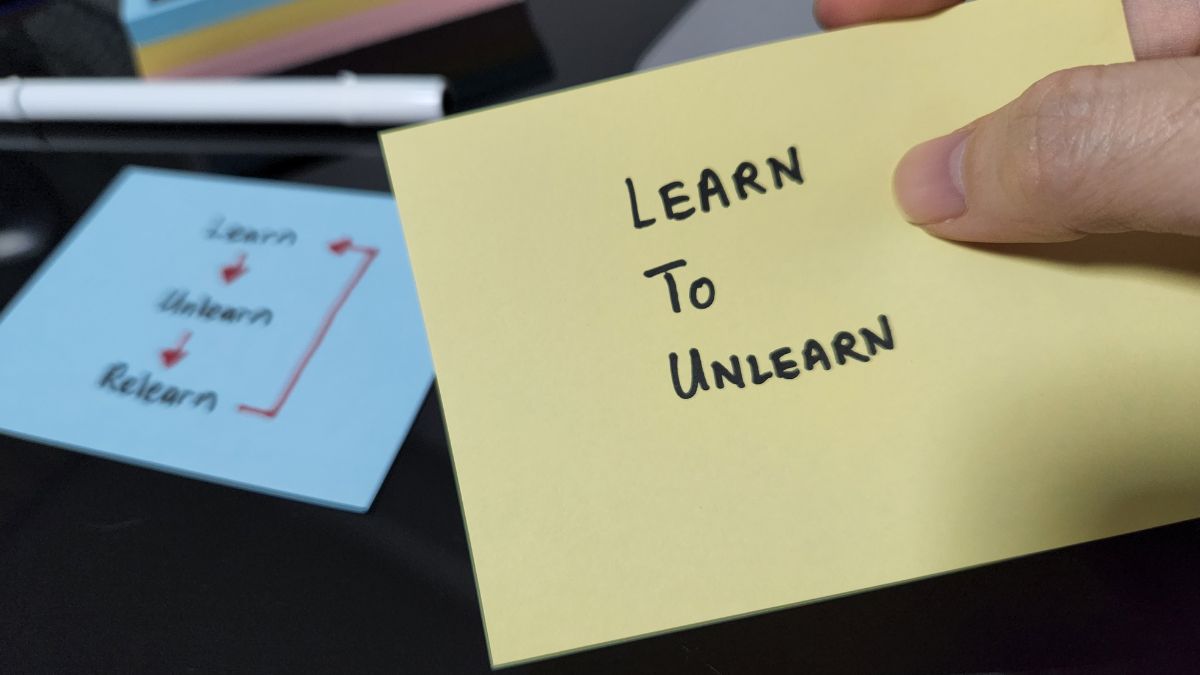
What stalls experienced sellers isn’t ignorance. It’s inertia.
Over time, successful reps develop automatic patterns:
- The demo reflex
- The discount reflex
- The “push forward” reflex
These are not flaws. They are habits reinforced by past wins.
But modern B2B environments evolve faster than habits do.
Organizational research shows that improvement requires deliberate unlearning—intentionally discarding obsolete routines to make space for better ones.
Adding new techniques on top of old reflexes creates conflict. Replacing cue-behavior loops creates change.
For example:
Trigger: Technical question
Old response: Immediate product demo
New response: Pause → Clarify risk exposure → Quantify impact → Decide advance vs. slow down
The shift must be rehearsed in real selling contexts—inside CRM workflows, pipeline reviews, and weekly cadences.
Behavior change happens at the moment of choice—not in the training room.
3) Hard-Wire Transfer: Coaching Beats Content
Most selling skills training fails in the aftercare.
Research consistently shows that manager and peer support are stronger predictors of long-term behavior change than the training content itself.
Experienced sellers do not need more inspiration.
They need structured reinforcement.
To improve sales performance sustainably:
- Define clear evidence standards for each pipeline stage
- Align coaching conversations to those standards
- Conduct weekly peer deal reviews
- Tie behavioral metrics to forecast discussions
When coaching reinforces new selling behaviors, adoption becomes visible.
Without reinforcement, even the most sophisticated B2B sales training fades into memory.
Training is not an event.
It is a system.
4) Train for Retention — Not Euphoria
A powerful workshop can create emotional momentum.
But revenue does not respond to euphoria. It responds to retention.
Cognitive research strongly supports spaced learning and retrieval practice. When knowledge is revisited over time and actively recalled (rather than passively reviewed), retention improves dramatically.
For experienced sellers, this means:
- Short scenario-based retrieval prompts
- Interleaved practice (qualification, stakeholder mapping, value framing mixed together)
- 2–5 minute behavioural nudges incorporated into CRM or existing enablement systems
- Reinforcement over 4–6 weeks minimum
Instead of one large bootcamp, think rhythm.
Small, repeated, applied recall builds durable capability.
In sales training, higher memory retention often determines better in field performance.
5) Protect Identity: Psychological Safety Drives Adaptation
Experienced salespeople are not just ‘technicians. They carry identity.
Years of performance build self-concept. When training challenges long-held methods, it can unintentionally threaten status.
If learning feels like correction, resistance rises.
But in environments with strong psychological safety—where it is acceptable to say “I might be wrong” or “I missed a stakeholder”—adaptation accelerates.
Modern B2B sales requires intellectual humility:
- Admitting assumptions
- Testing deal hypotheses
- Updating strategy mid-cycle
The sales training must preserve professional dignity while enabling recalibration.
Confidence is valuable.
Calibrated confidence is powerful.
When it is safe to question, experts evolve faster.
Why These Five Rules Matter in Our Selling Skills Training
Experienced sellers struggle in traditional sales training because:
- Rookie-oriented design overloads expert cognition
- Habit patterns override new knowledge
- Coaching systems fail to reinforce change
- Memory decay erodes adoption
- Identity friction blocks experimentation
When these five factors are addressed, something shifts.
Training stops being motivational ‘theater’. It becomes intentional behavioral re-designing
Story Close: From Activity to Predictability
Back to Anita.
We did not “motivate” her harder.
We rebuilt her decision routines. Installed manager checkpoints tied to pipeline evidence. Introduced peer deal reviews. Embedded spaced micro behavioural changes tied to live accounts.
Three months later, her pipeline was smaller—but real.
Fewer zombie deals.
Cleaner qualification.
Sharper stakeholder mapping.
Stronger forecast confidence.
That is what mastery looks like in modern B2B sales.
Less performance ‘theater’.
More transfer.
More predictability.
If your experienced sales team attends selling skills training but behaviors remains unchanged, the issue is not their experience.
It is the program design. And design can be rebuilt.
FAQ
Q1: Why do seasoned reps often say training feels “too basic”?
Because much corporate training is optimized for novices. The Expertise Reversal Effect shows novice supports can hinder experts by adding redundant cognitive load; expert‑fit design uses minimal guidance with complex, realistic tasks.
Q2: How do we make sure new skills survive the quarter?
Build work‑environment supports—manager and peer coaching, evidence‑based stage criteria, and weekly cadences. Research shows these factors strongly predict transfer and long‑term sustainment.
Q3: What cadence works best after a workshop?
Use Spacing and Micro practice for 4–6 weeks: brief, doable action-based behaviors that can be applied in the current CRM/enablement process while keeping disruption level low. This approach reliably improves retention and discrimination across domains.
Q4: With larger buying groups becoming more complex, how should we approach training?
One of the significant changes is that more stakeholders and buyers are already progressing far in the evaluation process even before first contact. Hence the area we should focus is on stakeholder navigation, qualification, and outcome framing—and practice them in a real live scenario.
Q5: How do we reduce resistance from veteran sellers?
Make learning identity‑safe. Foster Psychological Safety so expert sellers can test and revise assumptions without status loss, and coach calibrated confidence to avoid over‑ or under‑estimation traps.
Transform your sales team today with TRAINETasia—learn proven strategies from Shane Lee’s training to improve performance, close more deals, and drive sustainable business growth. Schedule an appointment now.